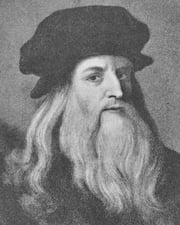
Leonardo da Vinci
The Universal Genius
Why They Changed Society
Leonardo da Vinci embodies the limitless potential of the human mind. The Mona Lisa and The Last Supper are among the most recognized artworks in history, defining Western art. But his genius extended far beyond painting — his notebooks contain designs for flying machines, armored vehicles, solar power, and hydraulic engineering, centuries before they were realized. His anatomical studies, based on dissecting over 30 human bodies, were more accurate than any before the 20th century. Leonardo proved that art and science are not opposites but complementary expressions of the same curiosity about the world. He is the original model for the term 'Renaissance man.'
Impact by the Numbers
7,000+
Notebook Pages
200+
Inventions Sketched
Timeline
Entered the service of Ludovico Sforza, beginning his most productive period as artist and engineer.
Began painting The Last Supper in Milan, one of the most reproduced religious paintings in history.
Began painting the Mona Lisa, which would become the most famous painting in the world.
Produced detailed anatomical drawings from human dissections, far ahead of contemporary medical knowledge.
Key Contributions
Mona Lisa (c. 1503)
Painted the world's most famous artwork, pioneering sfumato technique and psychological portraiture.
The Last Supper (1495)
Created one of the most influential religious paintings, revolutionizing composition and narrative in art.
Scientific Notebooks
Filled over 7,000 pages with designs for flying machines, anatomy, engineering, and optics — centuries ahead of their time.
Anatomical Studies
Produced the most accurate human anatomical drawings until the 20th century through rigorous dissection.
Notable Quotes
“Learning never exhausts the mind.
“Simplicity is the ultimate sophistication.
“I have been impressed with the urgency of doing. Knowing is not enough; we must apply. Being willing is not enough; we must do.