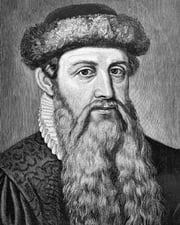
Johannes Gutenberg
Inventor of the Printing Press
Why They Changed Society
Gutenberg's printing press was the most transformative invention of the second millennium. Before movable type, books were hand-copied — expensive, rare, and controlled by elites. Gutenberg's press made books affordable and abundant, democratizing knowledge for the first time in human history. Within 50 years of his invention, over 20 million volumes had been printed. The press enabled the Protestant Reformation, the Scientific Revolution, the spread of literacy, the rise of newspapers, and the concept of intellectual property. Every subsequent information revolution — from the telegraph to the internet — traces its lineage to Gutenberg's workshop in Mainz.
Impact by the Numbers
20 million
Books Printed by 1500
Revolutionary
Literacy Rate Impact
Timeline
Developed the movable-type printing press, combining oil-based ink, the hand mold, and a wooden press.
Printed the Gutenberg Bible (42-line Bible), the first major book produced with movable type in Europe.
Within 50 years, printing presses across Europe had produced over 20 million volumes.
Key Contributions
Movable Type Printing Press (c. 1440)
Invented the system of movable type that made mass book production possible for the first time.
Gutenberg Bible (1455)
Produced the first major book printed with movable type, a masterpiece of printing quality still admired today.
Democratization of Knowledge
Made books affordable, spreading literacy and enabling the Renaissance, Reformation, and Scientific Revolution.
Notable Quotes
“It is a press, certainly, but a press from which shall flow in inexhaustible streams the most abundant and most marvelous liquor that has ever flowed to relieve the thirst of men.
“God suffers in the multitude of souls whom His word can not reach. Religious truth is imprisoned in a small number of manuscript books which confine instead of spread the public treasure.