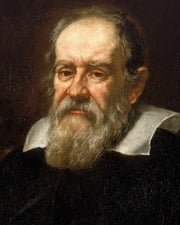
Galileo Galilei
Father of Modern Observational Science
Why They Changed Society
Galileo Galilei did more than discover celestial bodies — he changed how humanity discovers truth. By turning his improved telescope to the sky, he found Jupiter's moons, Venus's phases, sunspots, and the Milky Way's stars, providing undeniable evidence for the Copernican heliocentric model. More importantly, he insisted that nature must be understood through observation and mathematics, not authority and scripture — establishing the scientific method that would fuel every subsequent advance in human knowledge. His persecution by the Inquisition became a defining symbol of the conflict between free inquiry and dogma, and his vindication a triumph for science itself.
Impact by the Numbers
4
Jupiter Moons Discovered
20x
Telescope Magnification
Timeline
Built an improved telescope with 20x magnification and turned it toward the heavens.
Discovered four moons of Jupiter, proving not everything orbited the Earth.
Published 'Dialogue Concerning the Two Chief World Systems,' defending heliocentrism.
Found guilty of heresy for supporting heliocentrism, placed under house arrest for life.
Key Contributions
Telescopic Astronomy (1609)
Pioneered the use of the telescope for astronomical observation, revealing the true nature of the cosmos.
Discovery of Jupiter's Moons (1610)
Found four moons orbiting Jupiter, proving that not all celestial bodies orbit the Earth.
Scientific Method
Championed observation and experiment over authority, laying the foundation for modern science.
Notable Quotes
“And yet it moves.
— Attributed, after recanting heliocentrism before the Inquisition, 1633
“In questions of science, the authority of a thousand is not worth the humble reasoning of a single individual.
“Mathematics is the language in which God has written the universe.