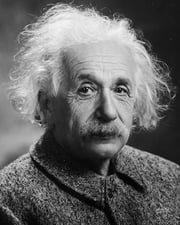
Albert Einstein
Architect of Modern Physics
Why They Changed Society
Albert Einstein reshaped humanity's understanding of the universe. His special theory of relativity (1905) showed that space and time are interwoven, and his general theory of relativity (1915) revealed that gravity is the curvature of spacetime itself — predictions confirmed by the detection of gravitational waves a century later. His photoelectric effect work launched quantum mechanics. E=mc² unlocked the understanding of nuclear energy. GPS satellites must account for his relativistic effects to function accurately. Einstein's work enabled technologies from nuclear power to semiconductor physics to cosmological observation, and his name became synonymous with genius itself.
Impact by the Numbers
Yes
GPS Relies on Relativity
E=mc²
Nuclear Energy Foundation
Timeline
Published four revolutionary papers on the photoelectric effect, Brownian motion, special relativity, and mass-energy equivalence.
Published the general theory of relativity, describing gravity as the curvature of spacetime.
Awarded the Nobel Prize for his discovery of the law of the photoelectric effect.
Wrote to President Roosevelt warning of the potential for atomic weapons, leading to the Manhattan Project.
Key Contributions
Special Relativity (1905)
Showed that space and time are relative, and that nothing can travel faster than light.
E=mc² (1905)
Revealed mass-energy equivalence, the principle behind nuclear energy and the foundation of modern physics.
General Relativity (1915)
Described gravity as the curvature of spacetime, predicting black holes, gravitational waves, and the expanding universe.
Photoelectric Effect (1905)
Explained light as quanta (photons), launching quantum mechanics and enabling solar cells and digital cameras.
Notable Quotes
“Imagination is more important than knowledge. Knowledge is limited. Imagination encircles the world.
“The important thing is to not stop questioning. Curiosity has its own reason for existence.
“If you can't explain it simply, you don't understand it well enough.