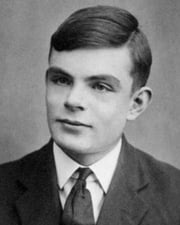
Alan Turing
Father of Computer Science
Why They Changed Society
Alan Turing's contributions to humanity are immeasurable. His 1936 paper introduced the Turing machine, providing the theoretical foundation for all modern computers. During World War II, his work at Bletchley Park breaking the Enigma code is estimated to have shortened the war by two years, saving millions of lives. After the war, he designed one of the first stored-program computers and proposed the Turing Test, launching the field of artificial intelligence. Despite facing persecution for his identity, his intellectual legacy endures as the foundation of the digital age. The Turing Award — computing's Nobel Prize — bears his name.
Impact by the Numbers
14 million
Lives Saved (WWII)
2 years
War Shortened By
Timeline
Published 'On Computable Numbers,' introducing the Turing machine and formalizing the concept of algorithms.
Joined the Government Code and Cypher School, beginning work on breaking the Enigma code.
Designed the Bombe, an electromechanical device that dramatically sped up breaking Enigma-encrypted messages.
Proposed the design for the Automatic Computing Engine, one of the first stored-program computer designs.
Published 'Computing Machinery and Intelligence,' proposing the Turing Test for machine intelligence.
Received a posthumous royal pardon from Queen Elizabeth II, 59 years after his death.
Key Contributions
Turing Machine (1936)
Created the theoretical model of computation that underpins every modern computer.
Enigma Codebreaking (1940-1945)
Broke the Nazi Enigma code, helping the Allies win WWII and saving millions of lives.
Bombe Machine (1940)
Designed the electromechanical Bombe that could rapidly test Enigma settings.
Turing Test (1950)
Proposed the foundational test for machine intelligence, launching the field of AI.
Notable Quotes
“We can only see a short distance ahead, but we can see plenty there that needs to be done.
— Computing Machinery and Intelligence, 1950
“Sometimes it is the people no one can imagine anything of who do the things no one can imagine.
“A computer would deserve to be called intelligent if it could deceive a human into believing that it was human.
— Computing Machinery and Intelligence, 1950